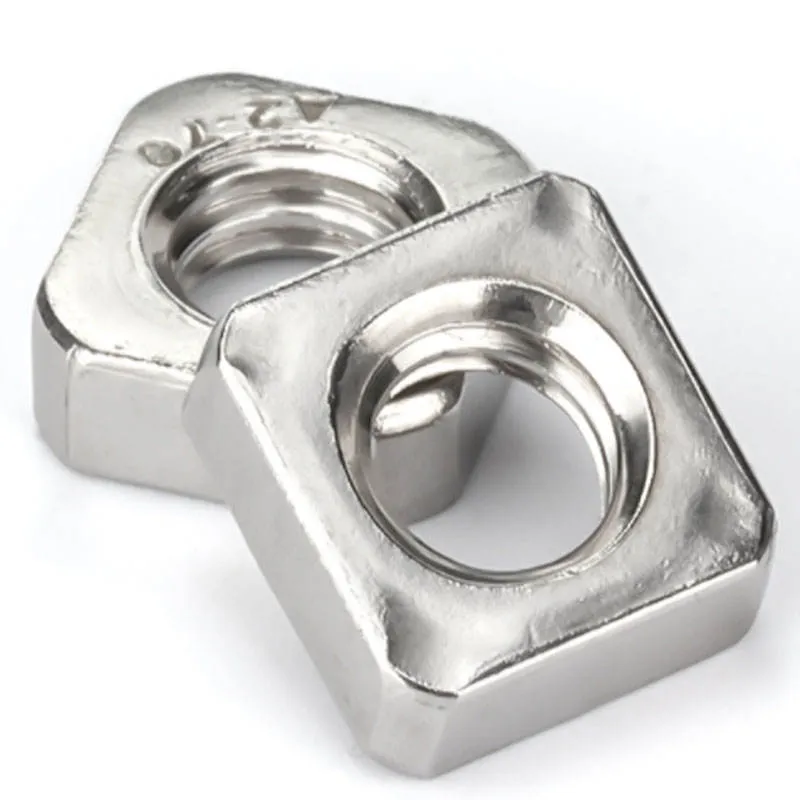
Square Nut OEM RFQ Callouts
OEM buyers who only write “square nut” or “four-sided nut” on channel and low-profile BOMs often get dual quotes: one desk assumes a square / four-sided nut for wrench or channel fit, another substitutes a flange nut, tee nut, cage nut, coupling nut, weld nut, clinch nut, or a plain hex nut. This Ruike (Ningbo Hongyuan Precision Hardware Manufacturing Co., Ltd. / HY) guide locks square nut OEM RFQ callouts in buyer English. It complements—not replaces—the sibling flange nut OEM RFQ (integrated washer flange under hex), the tee nut OEM RFQ (pronged wood / panel insert), the cage nut OEM RFQ (clip-on / spring float in square hole), the coupling nut OEM RFQ (long hex joining two male threads), the weld nut OEM RFQ (projection/spot weld retention), the clinch nut OEM RFQ (press-in / self-clinch sheet retention), the rivet nut OEM RFQ (blind install), the self-clinching nut OEM RFQ, the threaded rod OEM RFQ, the stud bolt OEM RFQ, and the blind rivet OEM RFQ.
Plant context: About Us. Browse related hardware under nuts. Hub index: Guides. Industry context: Applications. General RFQ questions: FAQ.
What should an OEM RFQ freeze for a square nut?
A square-nut RFQ must freeze square / four-sided nut style, across-flats size, thickness, thread series and class, and material/finish—so buyers cannot silent-swap a flange nut, tee nut, cage nut, coupling nut, weld nut, clinch nut, or hex nut. Name “square nut”; attach PDF/STEP and open Get a Quote on one enquiry thread.
What a square nut means on an HY RFQ
A square nut is a four-sided nut whose flats give wrench purchase or sit in a channel / low-profile pocket without a hex outline. Buyers name square / four-sided style, across-flats size, thickness, thread series and class, and material/finish. It is not a flange / serrated flange nut with an integrated washer flange, not a tee / T-nut with prongs into wood, not a cage / clip-on nut that floats in a square panel hole, not a coupling / extension nut that joins two male threads, not a weld nut permanently joined by projection or spot welding, not a clinch / self-clinching nut that cold-forms into sheet, and not a plain hex nut unless the Rev explicitly allows that swap. Use this page when the RFQ language is “square nut / four-sided nut”; use the flange nut OEM RFQ for flanged hex, the tee nut OEM RFQ for pronged wood inserts, the cage nut OEM RFQ for square-hole clip float, or the coupling nut OEM RFQ for rod joiners.
When OEM drawings should freeze square-nut geometry
- Channels, tracks, or low-profile pockets that need a four-sided nut outline rather than hex.
- BOMs that previously received flange nuts, tee nuts, cage nuts, coupling nuts, weld nuts, clinch nuts, or hex nuts when engineering needed a square nut.
- Programs that mix “square nut / four-sided” language with anonymous “panel nut,” “channel nut,” or scrap-hex lines.
- Jobs that still need mating bolt engagement—see also how to measure screw length.
Square / four-sided vs flange / tee / cage — RFQ comparison
| Callout | Square nut (this page) | Flange / tee / cage / coupling path |
|---|---|---|
| Buyer language | Square nut · four-sided nut | Flange / serrated flange · tee / T-nut · cage / clip-on · coupling / extension · weld / clinch · hex |
| Function | Four flats for wrench / channel / low-profile fit | Integrated washer flange · prongs into wood · square-hole float · rod join · weld / press-in |
| Key callouts | Across-flats, thickness, thread, material | Flange Ø/serration · prongs/host · cage/square hole · length/both-end threads |
| Typical mix-up | “Channel nut” or “panel nut” without A/F or thickness | Silent swap to flange, tee, cage, coupling, weld, clinch, or hex |
Callouts that keep square-nut intent clear
- Family — square nut / four-sided—not “flange similar,” “tee any,” “cage any,” “coupling any,” or hex unless allowed.
- Across-flats — A/F size for wrench or channel pocket as on the Rev.
- Thickness — nut height / thickness as owned by the drawing.
- Thread — series and class for the mating bolt as on the Rev.
- Material / finish — named for the nut body; finish does not invent A/F or thickness.
Cross-reference pitfalls
Do not treat square nuts as drop-in flange nuts, tee nuts, cage nuts, coupling nuts, weld nuts, clinch nuts, self-clinching nuts, or hex nuts. Do not assume a hex outline meets a four-sided channel pocket without re-approval. Across-flats and thickness stay on the RFQ with the thread callout. For flanged hex see the flange nut OEM RFQ; for pronged wood inserts see the tee nut OEM RFQ; for floating panel anchors see the cage nut OEM RFQ; for rod joiners see the coupling nut OEM RFQ; for welded retention see the weld nut OEM RFQ; for press-in sheet retention see the clinch nut OEM RFQ and self-clinching nut OEM RFQ.
What to send with the RFQ
Attach the controlling PDF/STEP, name square / four-sided nut intent, across-flats size, thickness, thread series and class, material/finish, qty band, and destination. Open Get a Quote so one enquiry thread owns the revision. Ruike will not invent ISO certificates, MOQ tables, or lead-time promises on this public page.
FAQ — square nut OEM RFQ
What is a square nut on an OEM RFQ?
It is a four-sided nut whose flats give wrench purchase or sit in a channel / low-profile pocket. Freeze square style, across-flats size, thickness, thread, and material—do not stop at “square nut,” “channel nut,” or “panel nut.”
How does a square nut differ from a flange nut, tee nut, or cage nut?
A square nut freezes a four-sided outline for wrench or channel fit. A flange nut has an integrated washer flange under a hex; a tee nut uses prongs into wood or panel; a cage nut floats in a square metal hole. Use the flange nut OEM RFQ, tee nut OEM RFQ, or cage nut OEM RFQ when the drawing owns those forms—do not duplicate the same RFQ on both pages.
Can I substitute a hex nut for a square nut?
Not by default. Hex outlines often fail channel / low-profile pockets that own four flats. Freeze across-flats and thickness the Rev owns. If the BOM says “flange,” “tee,” “cage,” “coupling,” or “weld,” follow those OEM RFQ pages instead.
How should across-flats and thickness be called out?
State across-flats size, thickness, thread series and class, and material/finish. For mating bolt engagement length, see how to measure screw length.
What should I send so Ruike can quote square nuts?
Send PDF/STEP, square / four-sided style, across-flats, thickness, thread series, material/finish, qty band, and destination via Get a Quote. Ruike does not invent ISO certs, MOQ, or lead times on your behalf.