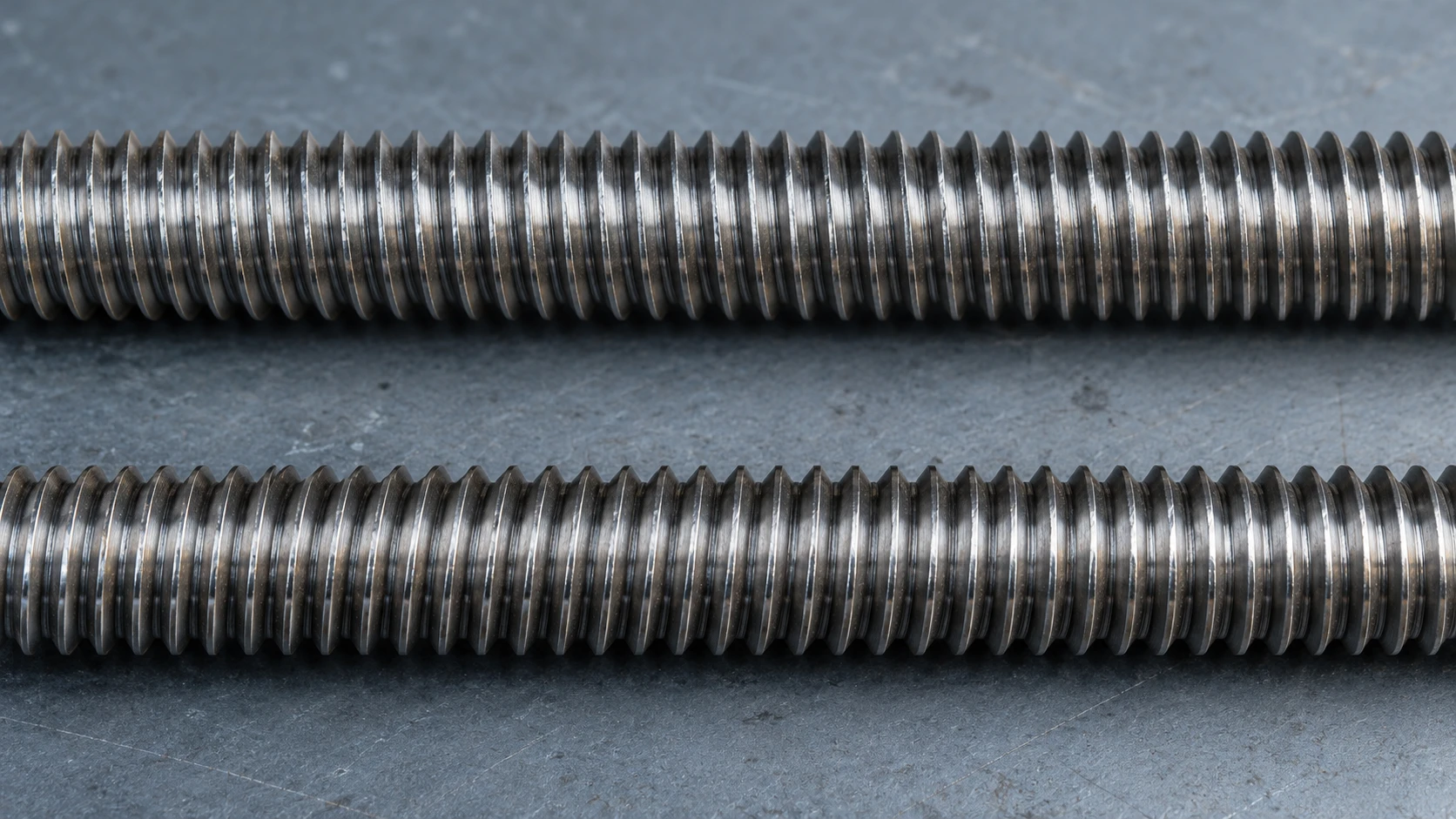
Cover: AI-generated editorial illustration. Catalogue photographs below illustrate visible product geometry, not verified dimensions or performance.
A flange bolt and a bolt with a separate washer can both provide a broader bearing interface, but they are not interchangeable solely because their outside diameters look similar. Compare the actual contact area, mating material, hole geometry, available space and tightening conditions. An integral flange reduces the number of loose parts; a separate washer provides an independently specified component. Neither arrangement automatically establishes resistance to vibration loosening or suitability for a particular joint.
Compare the interface, not just the head outline
| Question | Integral flange | Separate washer |
|---|---|---|
| What contacts the component? | The flange bearing face | The washer face |
| How is bearing geometry specified? | As part of the fastener drawing | Through the washer dimensions and specification |
| How many loose components are handled? | No separate washer if the approved joint omits it | An additional component unless retained in an assembly |
| What must fit the recess? | Flange diameter, head height and tool envelope | Washer diameter, thickness, head and tool envelope |
| What changes in a substitution? | Contact and tightening conditions may change | Stack height and additional interfaces may change |
Do not assume the full visible flange diameter bears on the part. Chamfers, reliefs, a hole edge or a raised feature may reduce the effective contact. On a thin or soft component, the local support and deformation response matter as well as the nominal area.

A simple bearing-area calculation
For a hypothetical flat annular contact, projected area is A = π(D² − d²)/4. With an effective outside contact diameter D of 16 mm and an inside contact diameter d of 7 mm, A is approximately 162.6 mm². If an illustrative axial load is 8,000 N, average pressure F/A is approximately 49.2 N/mm², or 49.2 MPa.
Reducing the effective outside diameter to 12 mm, while keeping the same 7 mm inner diameter, gives 74.6 mm² and approximately 107.2 MPa. These are geometry calculations, not allowable values. They do not model uneven contact, flange bending, washer deformation, local yielding or a serrated interface. They also do not show that a component passes an engineering requirement.
Why a flange does not settle the locking question
A smooth bearing face and a serrated bearing face are different interfaces. Their appearance alone cannot establish a validated locking performance. Define the retention requirement for the real assembly, including its service loads and approved installation method. Avoid treating a broad flange, an ordinary flat washer and a purpose-designed locking element as the same feature.
Any substitution should also trigger a review of the tightening specification. Changes at the bearing interface can affect the relationship between applied torque and achieved clamp force. Do not carry across a torque value just because thread size is unchanged.

Four checks before replacing a washer with a flange
- Seating: check the actual contact ring, hole edge, chamfer and nearby raised features.
- Envelope: verify the flange or washer can enter the recess and leave room for the installation tool.
- Stack: recalculate the length through the joint and the available thread engagement after removing or adding a washer.
- Validation: review the assembly procedure, retention needs and inspection criteria with the responsible engineer.
Our screw-length guide explains measurement reference points. The screw and washer assembly article covers checking the specified components; it does not make every washer arrangement interchangeable.
Write a useful purchase description
Include the thread and length, head and bearing-face geometry, smooth or serrated interface as required, material and finish requirements, mating-hole dimensions, available recess and tool clearance, and the approved drawing revision. For a separate washer, state its specification and orientation if applicable. Ask the supplier to flag deviations rather than selecting a visually similar substitute.
FAQ
Can every flange bolt eliminate a washer?
No. Follow the approved joint design. A washer may have a specific spacing, surface, insulation or other function that a flange does not provide.
Is a larger flange always better?
No. Available space, seating geometry and stiffness can limit the useful bearing area. Evaluate the real interface.
Does a serrated flange guarantee no loosening?
No. Suitability and performance require application-specific validation; the visible serrations alone are not test evidence.
Should screw length stay the same after removing a washer?
Recheck it. Removing washer thickness changes the assembled stack and may increase protrusion or reduce bottom clearance in a blind hole.
Send the joint details for review
Share your drawing, mating-hole section and current washer arrangement with shizhanhao6@gmail.com, WhatsApp +65 98695891, or WeChat Ethan1. Identify whether the enquiry concerns an approved new design or a proposed substitution.