Choose a blind rivet whose published grip range covers the complete thickness interval of the assembled joint, not just its nominal thickness. Then check the specified hole, materials, head style and installation system. Grip range and overall rivet length are different specifications.
Start with the assembled stack
List every layer captured between the factory head and the formed blind-side head. Use the drawing tolerances and the intended assembled condition. A seal, coating or spacer may change the effective stack; establish how it behaves during installation instead of treating its free thickness as a guaranteed installed value.
For rigid layers, adding the individual minimum and maximum thicknesses provides a conservative screening interval. This arithmetic checks dimensional coverage only. It does not validate joint strength, sealing or the installation process.
Screen the grip range in five steps
- Collect the drawing revision, material stack list and any compressible layers (gasket, coating, spacer).
- Compute the minimum and maximum rigid-stack thickness from each layer’s tolerance band.
- Compare that interval with the grip range published for the exact rivet part number—not a catalog family headline.
- Record the required hole diameter/tolerance, head style, body/mandrel materials and approved setting tool.
- Plan first-article samples near both stack extremes before releasing the part for production.
If any step is incomplete, keep the selection provisional. A grip match on paper is still only a dimensional screen.
A worked tolerance example
Illustrative dimensions, not a Ruike product specification: sheet A is 1.50 ±0.10 mm and sheet B is 2.00 ±0.15 mm. The minimum stack is 1.40 + 1.85 = 3.25 mm; the maximum is 1.60 + 2.15 = 3.75 mm.
| Candidate grip range, illustrative | Screening result |
|---|---|
| 3.0–3.5 mm | Does not cover the 3.75 mm maximum |
| 3.5–4.0 mm | Does not cover the 3.25 mm minimum |
| 3.0–4.0 mm | Covers this interval; remaining application checks still required |
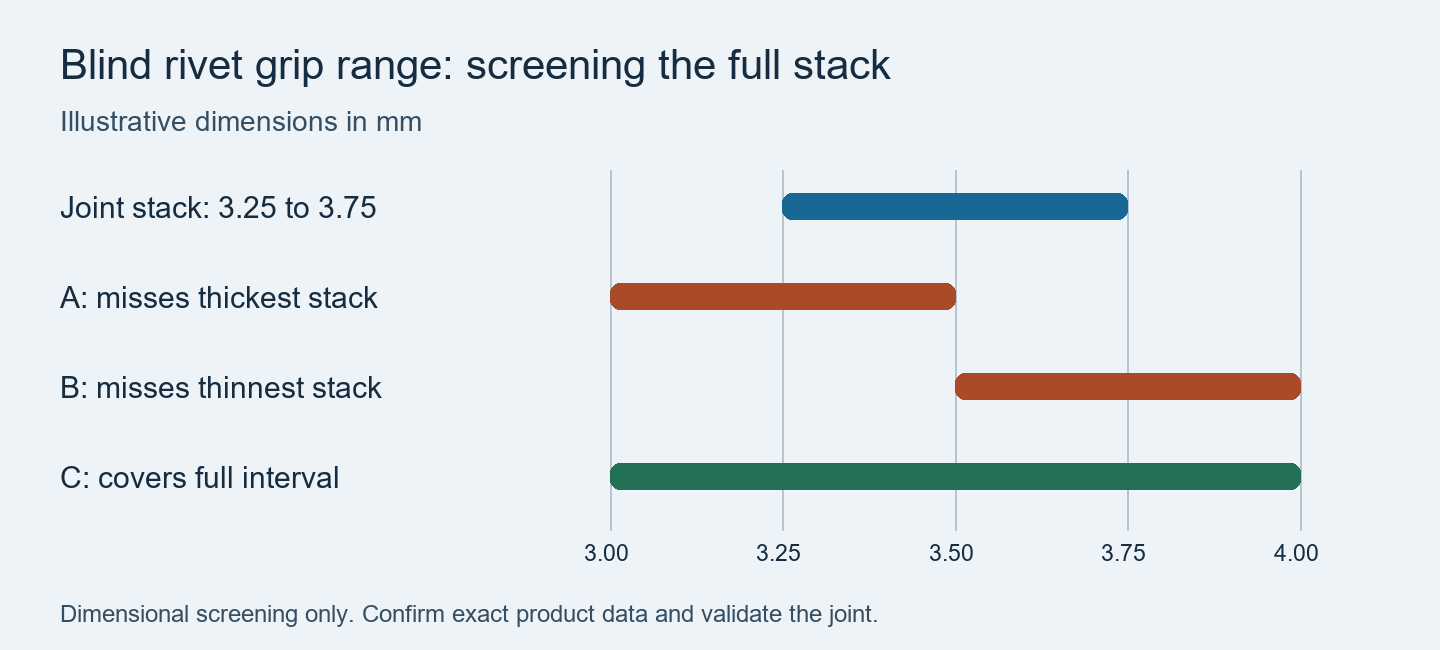
The third range is not a product recommendation. Obtain the actual manufacturer’s data for the exact part number, including any conditions on the stated limits. A wider range does not establish equivalent mechanical performance.
What the grip calculation leaves unresolved
| Check | Record before approval |
|---|---|
| Hole | Product-specific diameter and tolerance, alignment and burr condition |
| Materials | Both joined materials and the rivet body/mandrel specification |
| Access | Tool access on the setting side and room for blind-side formation |
| Performance | Required joint loads, sealing and environmental conditions |
| Installation | Approved tool, nosepiece and inspection criteria |
Do not substitute a universal hole tolerance for the selected rivet’s instructions. Likewise, a photograph of the visible head cannot establish the condition of an inaccessible blind-side head.
Make the first-article trial representative
Identify samples near the intended lower and upper stack limits and record their actual thickness. Use the production materials, hole preparation and approved installation equipment. Define acceptance criteria before setting the samples. Record the part number, lot, drawing revision, measured stack and inspection outcome so later substitutions can be assessed against the same conditions.
For compressible layers, obtain an application-specific installation assessment. The simple rigid-sheet calculation above does not model compression. Do not add unapproved washers or spacers just to bring an unsuitable rivet into range.
What to include in the first RFQ
- Drawing number and revision, with stack layers called out.
- Min/max assembled thickness (or the tolerance inputs used to calculate it).
- Hole size and preparation notes for each joined part.
- Preferred rivet family or incumbent part number, if any.
- Body/mandrel material preference and head style constraints.
- Quantity for sample vs production, plus any inspection or PPAP-style records required.
- Photos or notes on tool access and blind-side clearance.
Clear stack and hole data shorten review time more than a generic “multi-grip” request. Related reading: blind rivets product category.
FAQ
Is grip range the same as rivet length?
No. Grip range describes the supported joint thickness interval. Order using the exact product designation and its data sheet.
Can I approve a rivet from nominal sheet thickness alone?
No. Check the full stack interval and the remaining installation and performance requirements.
Does a multi-grip description guarantee compatibility?
No. Confirm the actual published limits and qualify the selected product in the joint.
Does passing the stack calculation prove strength?
No. It only establishes dimensional coverage against the stated grip limits.
Discuss your drawing with Ruike
Send your drawing, mating-part details, quantity and required inspection records to shizhanhao6@gmail.com. WhatsApp: +65 98695891. WeChat: Ethan1. Get a Quote.