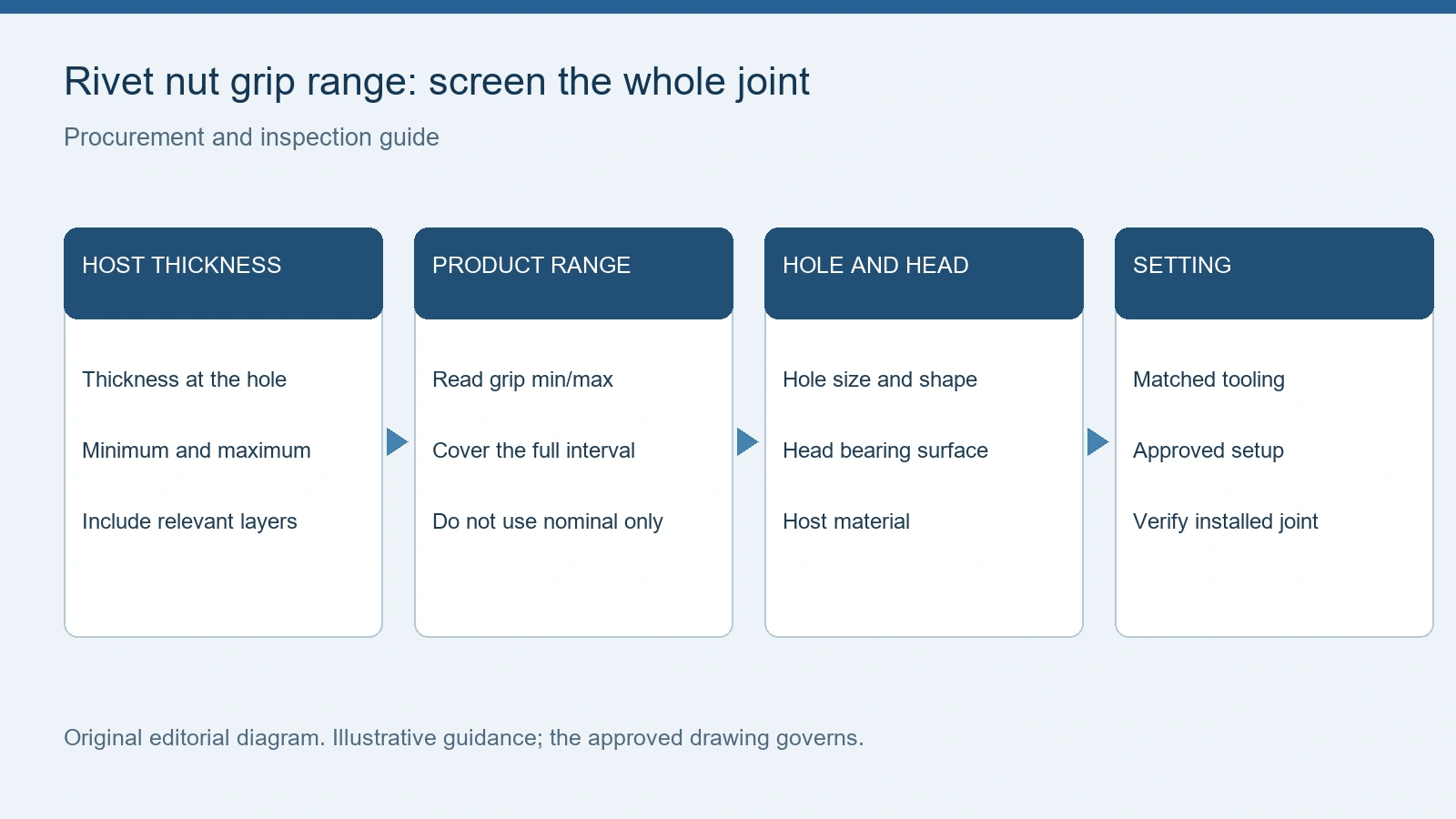
Select a rivet nut whose published grip range covers the host-material thickness interval at the installation hole, not only the nominal sheet thickness. Then confirm the specified hole diameter, host material, head style and installation tooling. Grip range and overall rivet-nut length are different specifications. Use this guide to screen candidates before first-article installation and before locking a part number on the drawing.
Read grip range against host thickness
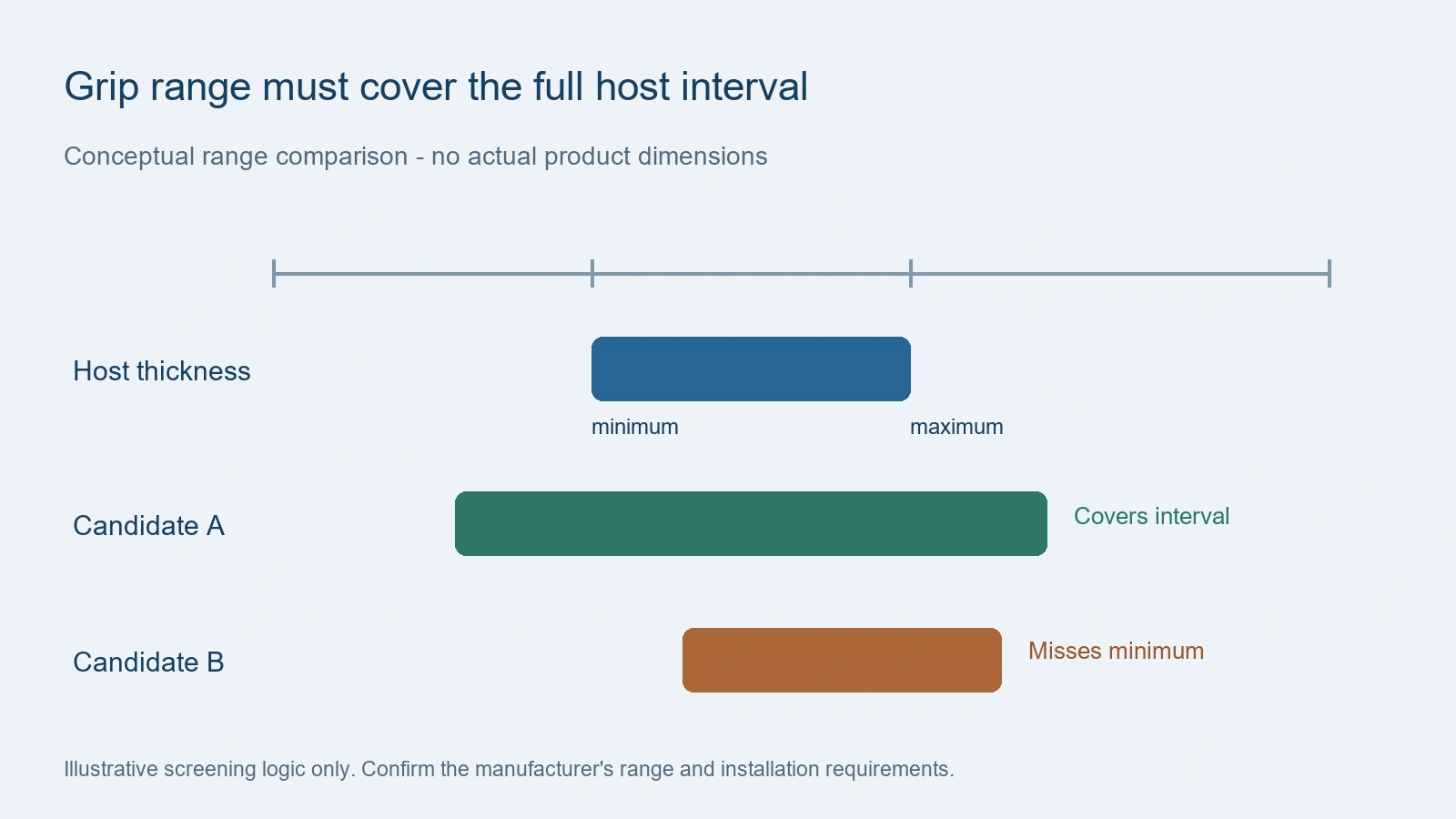
A rivet nut (also called a rivnut or blind nut insert) forms a captive threaded insert in sheet or tubular material when only one side is accessible. The grip range is the host-thickness interval the product is designed to clamp. Measure or calculate the thickness at the hole after any local forming, and include drawing tolerances. Do not assume the free sheet thickness equals the installed thickness if the panel is formed, embossed or stacked with a coating that changes local geometry.
For a single rigid host layer, the drawing minimum and maximum thicknesses give a screening interval. That arithmetic checks dimensional coverage only. It does not prove pull-out load, thread strength or corrosion performance.
A worked host-thickness example
Illustrative dimensions, not a Ruike product specification: aluminum panel thickness is 2.00 ±0.15 mm at the hole. The screening interval is therefore 1.85–2.15 mm.
| Candidate grip range, illustrative | Screening result |
|---|---|
| 0.5–1.5 mm | Does not cover the 1.85 mm minimum |
| 2.0–3.0 mm | Does not cover the 1.85 mm minimum |
| 1.5–2.5 mm | Covers this interval; remaining application checks still required |
The third range is not a product recommendation. Obtain the manufacturer’s data for the exact part number, including any conditions on the stated limits and recommended hole size. A wider grip range does not establish equivalent mechanical performance or thread class.
Checks the grip calculation does not replace
| Check | Record before approval |
|---|---|
| Hole | Product-specific diameter and tolerance, roundness, burr and edge distance |
| Host material | Sheet alloy or grade, hardness and any local heat-affected zone |
| Head style | Flat, countersunk or low-profile relative to flush and bearing needs |
| Thread | Size, pitch, class of fit and mating bolt specification |
| Installation | Approved tool, stroke or spin-pull settings and inspection criteria |
Do not substitute a generic “sheet metal hole” chart for the selected rivet nut’s instructions. A photograph of the installed head cannot prove backside bulge geometry or thread condition after forming.
Qualify on production-like samples
Install samples near the intended lower and upper host-thickness limits and record measured thickness at each hole. Use production hole preparation, host material and approved tooling. Define acceptance criteria before setting: flushness, spin-out resistance, thread gauge fit and any required pull-out sample. Record part number, lot, drawing revision, measured thickness and inspection outcome so later substitutions can be compared under the same conditions.
For soft, coated or thin hosts, obtain an application-specific installation assessment. Do not add unapproved spacers or washers solely to bring an unsuitable grip into range.
FAQ
Is grip range the same as rivet-nut length?
No. Grip range describes the supported host-thickness interval. Order using the exact product designation and its data sheet.
Can I approve a rivet nut from nominal sheet thickness alone?
No. Check the full thickness interval at the hole plus hole size, material, head style and tooling.
Does a multi-grip description guarantee fit?
No. Confirm the published limits for that part number and qualify the selected product in the host.
Does passing the thickness check prove pull-out strength?
No. It only establishes dimensional coverage against the stated grip limits.
Discuss your drawing with Ruike
Send your drawing, host-material details, quantity and required inspection records to shizhanhao6@gmail.com. WhatsApp: +65 98695891. WeChat: Ethan1.
Cover: AI-assisted editorial illustration, not a photograph of production, testing or an actual order. Product photographs in the article are identified separately.
Related assembly guidance
Blind rivet grip range and stack tolerance. Use the linked guide to review the related assembly considerations; product-specific acceptance still follows the approved drawing and specification.