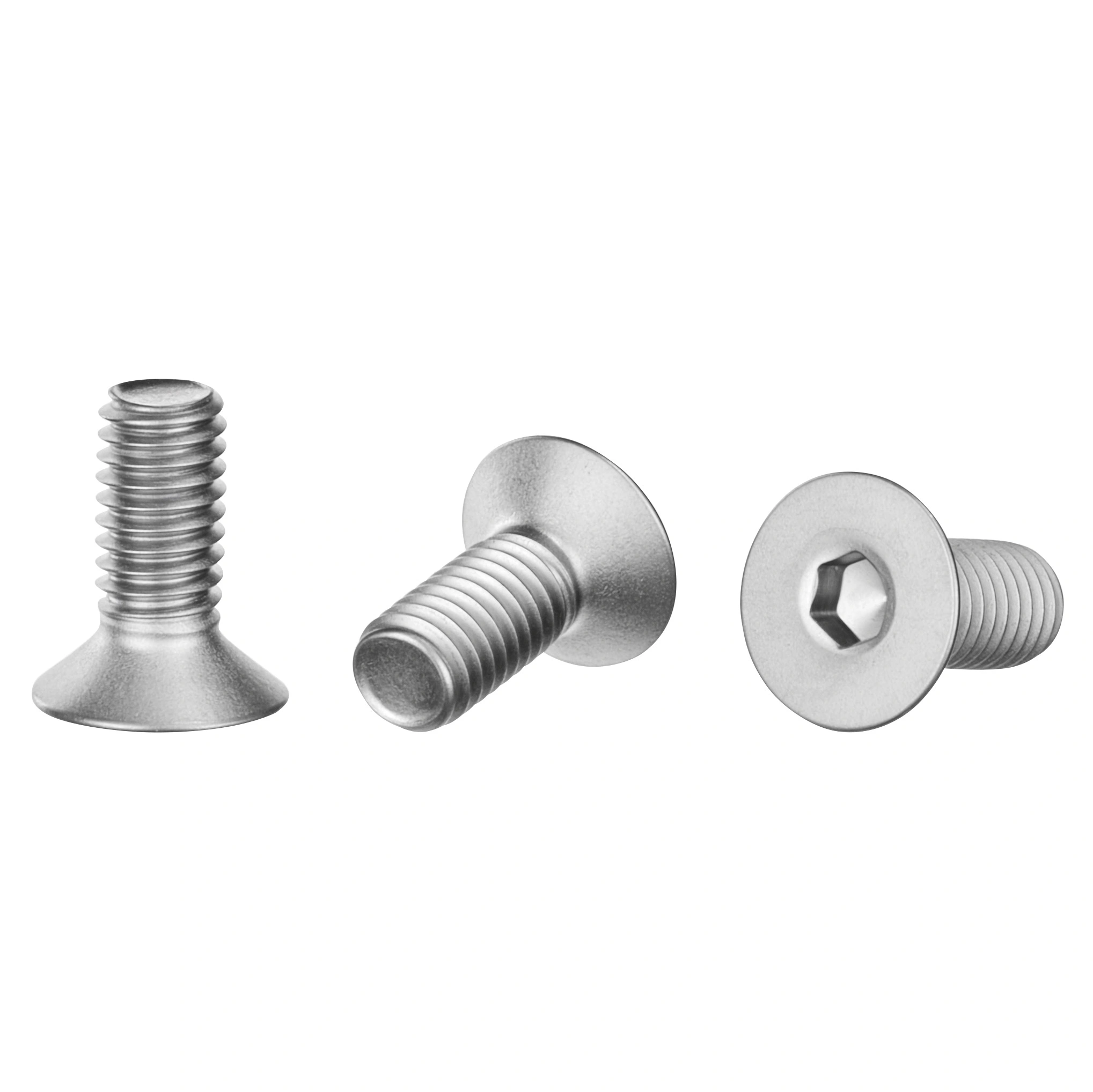
DIN 7991 Countersunk Socket OEM RFQ
OEM buyers calling only “countersunk socket screw” on mixed BOMs often get dual quotes: one desk assumes a DIN 7991 / ISO 10642 hexagon socket countersunk head, another substitutes a button-head socket, a slotted flat head, or a wood-screw geometry that will not gauge the seat. This Ruike (Ningbo Hongyuan Precision Hardware Manufacturing Co., Ltd. / HY) guide locks DIN 7991 countersunk-socket OEM RFQ callouts in buyer English. It complements—not replaces—the countersink vs counterbore note, the DIN 912 socket-cap guide, and the socket vs hex head comparison.
Plant context: About Us. Browse related hardware under screws, bolts, and nuts. Hub index: Guides. General RFQ questions: FAQ.
What DIN 7991 means on an HY RFQ
DIN 7991 (often paired with ISO 10642) names the metric hexagon socket countersunk head screw—not a button-head socket and not a generic flat-head wood screw. Head angle, socket size, and thread length still need their own lines. Freeze standard, M×pitch×length, material/class, and finish on the RFQ.
When OEM drawings should freeze DIN 7991 (or ISO 10642)
- Seats that are machined or formed as a countersink—not a counterbore for a socket-cap head.
- BOMs that previously received DIN 912 socket caps when engineering meant a flush countersunk head.
- Programs that must keep hexagon socket drive—not silent swaps to slotted or Phillips flat heads.
- Jobs that still name property class or A2/A4 stainless mark on the same countersunk-socket line.
DIN 7991 vs nearby head families — RFQ comparison
| Family | How to write it | Typical RFQ failure |
|---|---|---|
| DIN 7991 / ISO 10642 | Standard + M×pitch×length + material/class | Quoted as DIN 912 socket cap |
| DIN 912 / ISO 4762 socket cap | Cylindrical head + socket (see DIN 912 guide) | Quoted as countersunk flush head |
| Button-head socket | Named button-head standard | Quoted as DIN 7991 countersunk |
Callouts that keep DIN 7991 intent clear
- Standard — DIN 7991 and/or ISO 10642 as owned by the Rev—not “CSK socket similar.”
- Size — M×pitch × length with length datum called out (countersunk length rules matter).
- Seat — countersink angle/seat owned on the parent—pair with countersink vs counterbore.
- Drive — hexagon socket; do not assume slotted/Phillips substitutes.
- Material / class — property class or stainless mark as separate facts—see A2 vs A4 RFQ.
- Finish — plain / passivated / plated—named; plating does not invent head geometry.
What to send with the RFQ
Attach the controlling PDF/STEP, name DIN 7991 or ISO 10642 (or both if dual-listed), M×pitch×length with datum, seat/countersink notes if controlled, material/class or stainless mark, finish if controlled, qty band, and destination. Open Get a Quote so one enquiry thread owns the revision. Ruike will not invent ISO certificates, MOQ tables, or lead-time promises on this public page.
FAQ — DIN 7991 countersunk-socket OEM RFQ
What is a DIN 7991 screw on an OEM RFQ?
It is the metric hexagon socket countersunk head screw in the classic DIN series (often paired with ISO 10642). Name the standard, then still freeze size, material/class, and finish—do not stop at “countersunk socket.”
Is DIN 7991 the same as DIN 912?
No. DIN 912 / ISO 4762 is the cylindrical socket-cap head; DIN 7991 / ISO 10642 is the countersunk socket head. Keep them on separate lines—see DIN 912.
Does the parent need a countersink or a counterbore?
A DIN 7991 head expects a countersink seat. A counterbore is the usual seat for a socket-cap head. Freeze the seat type—see countersink vs counterbore.
Can I substitute a button-head socket for DIN 7991?
Not without a drawing change. Head height and seat geometry differ; write the owned standard on the Rev.
What should I send so Ruike can quote DIN 7991 parts?
Send PDF/STEP, standard callout (DIN 7991 / ISO 10642), M×pitch×length with datum, seat notes if controlled, material/class or stainless mark, finish if controlled, qty band, and destination via Get a Quote. Ruike does not invent ISO certs, MOQ, or lead times on your behalf.