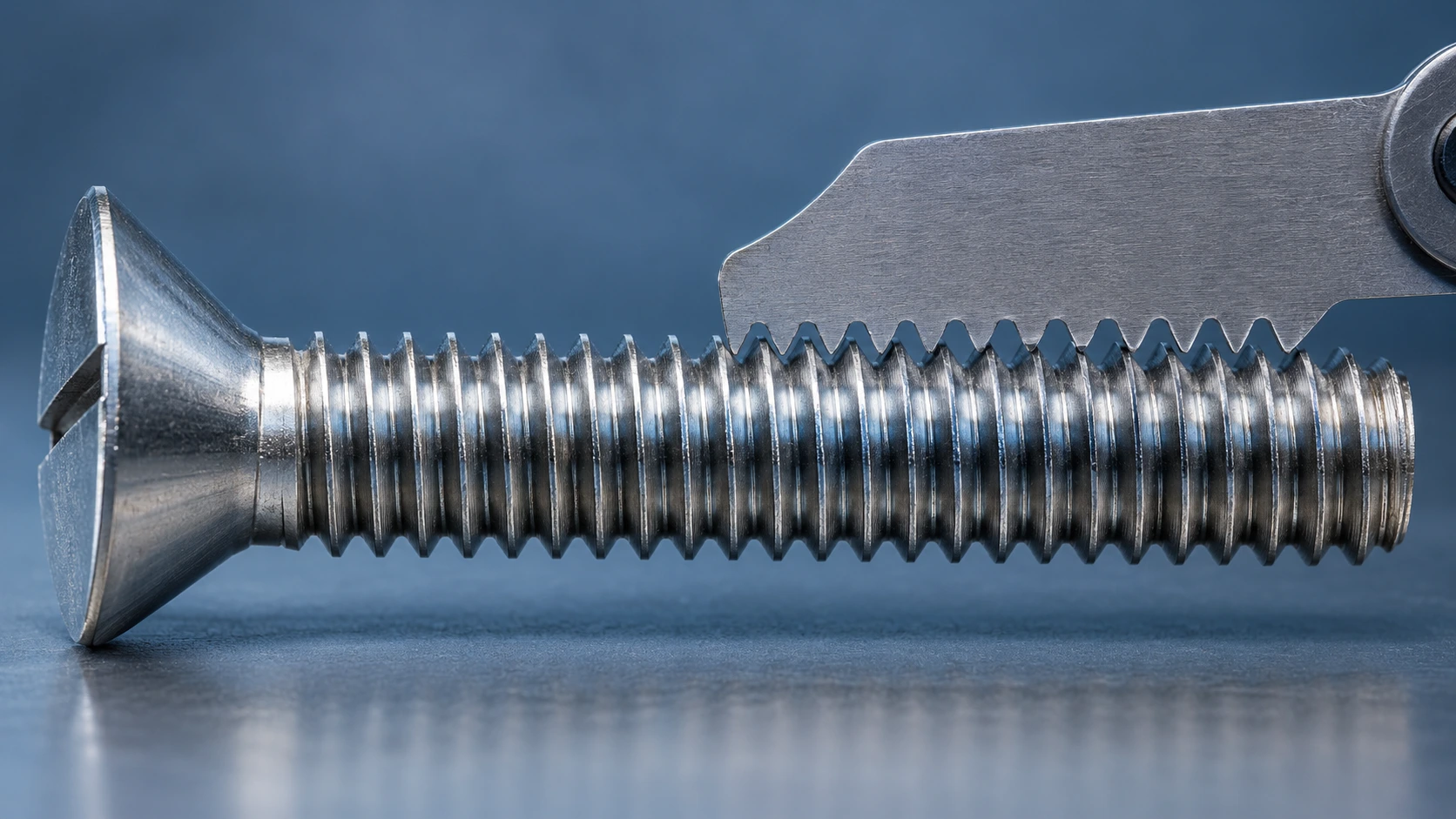
Coarse vs Fine Thread OEM RFQ Callouts
OEM buyers calling coarse vs fine thread on mixed metric/inch BOMs often get dual quotes: one desk assumes standard coarse pitch (or UNC), another substitutes a fine pitch (or UNF) “same diameter” blank that will not gauge. This Ruike (Ningbo Hongyuan Precision Hardware Manufacturing Co., Ltd. / HY) guide locks coarse vs fine thread OEM RFQ callouts in buyer English. It complements—not replaces—the metric vs inch fastener thread-system guide, the metric 6g/6h tolerance checklist, and the partial vs full thread note.
Plant context: About Us. Browse related hardware under screws, bolts, and nuts. Hub index: Guides. General RFQ questions: FAQ.
What coarse vs fine thread means on an HY RFQ
On this desk, coarse vs fine thread is a pitch-family choice for one nominal diameter—not material, finish, or strength. Metric “coarse” is usually the default pitch (e.g. M8×1.25); “fine” is a smaller pitch (e.g. M8×1). Inch UNC is coarse and UNF fine. Writing only “M8” or “1/4 screw” without pitch invites the wrong gage.
Pitch choice still needs diameter, length, thread length (full vs partial), property class or stainless mark, and finish. Coarse/fine alone does not freeze alloy, plating, or torque.
When OEM drawings should freeze coarse or fine pitch
- BOMs that previously received fine-pitch mates when engineering meant default coarse (or the reverse).
- Vibration or adjustment joints where engineering intentionally selected fine pitch—still name the pitch, do not rely on “fine implied.”
- Mixed metric/inch programs where UNC/UNF must stay segregated from ISO M×pitch.
- Tapped holes already cut to one pitch family—matching fasteners must call the same pitch.
Coarse vs fine — RFQ comparison
| Family | How to write it | Typical RFQ failure |
|---|---|---|
| Metric coarse | M×default pitch (e.g. M8×1.25) or “ISO coarse” | Quoted as M8×1 fine |
| Metric fine | M×named fine pitch (e.g. M8×1) | Quoted as default coarse |
| UNC (inch coarse) | Size-UNC (e.g. 1/4-20 UNC) | Quoted as UNF |
| UNF (inch fine) | Size-UNF (e.g. 1/4-28 UNF) | Quoted as UNC |
Callouts that keep pitch intent clear
- Thread system — ISO metric or Unified (UNC/UNF)—never both on one blank line.
- Pitch — write M×pitch or TPI; do not rely on “coarse/fine” adjectives alone.
- Tolerance — if controlled, name 6g/6H (or other class) separately from pitch family.
- Thread length — full vs partial remains its own callout.
- Material / class / finish — separate RFQ lines; pitch does not invent strength.
What to send with the RFQ
Attach the controlling PDF/STEP, name diameter × pitch (or UNC/UNF + TPI), length with datum, thread length, material/class or stainless mark, finish if controlled, qty band, and destination. Open Get a Quote so one enquiry thread owns the revision. Ruike will not invent ISO certificates, MOQ tables, or lead-time promises on this public page.
FAQ — Coarse vs fine thread OEM RFQ
What does coarse vs fine thread mean on an OEM RFQ?
It is the pitch family for a given diameter (metric default vs fine pitch, or UNC vs UNF). Always write M×pitch or size-UNC/UNF—do not stop at “M8” or “1/4 screw.”
Is metric coarse the same as UNC?
No. Metric ISO and Unified inch are different thread systems. Keep them on separate BOM lines—see metric vs inch.
Does choosing fine thread change material or strength?
No. Property class or stainless marks remain separate RFQ lines. Pitch family does not invent alloy, plating, or proof load.
What if my tapped hole is already fine pitch?
Match the fastener pitch to the existing tap. Call the exact M×pitch or UNF TPI on the RFQ so the quote does not default to coarse.
What should I send so Ruike can quote the right pitch?
Send PDF/STEP, diameter × pitch (or UNC/UNF + TPI), length with datum, thread length, material/class or stainless mark, finish if controlled, qty band, and destination via Get a Quote. Ruike does not invent ISO certs, MOQ, or lead times on your behalf.