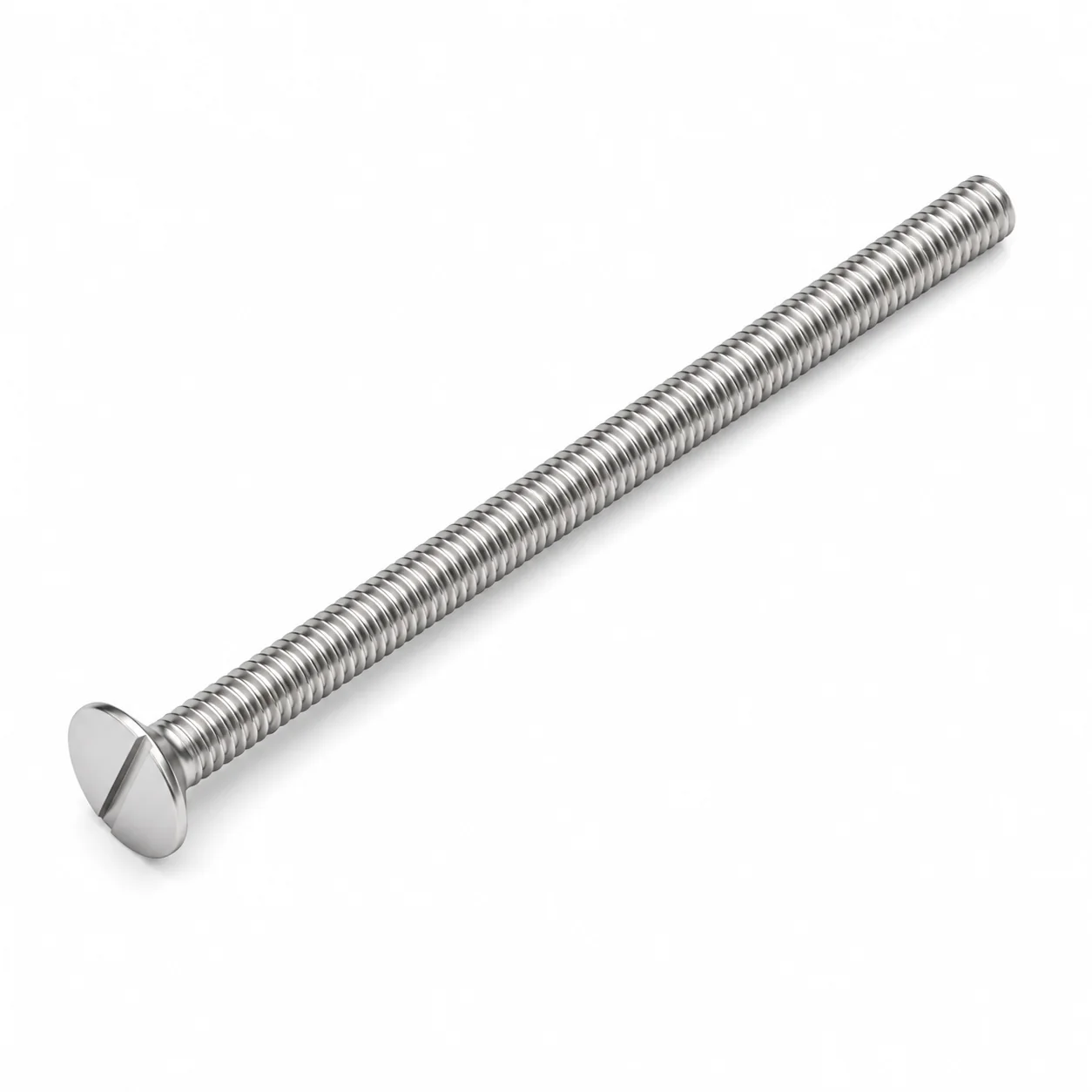
To measure screw thread pitch, measure along the screw axis between matching points on adjacent threads, or measure several equal intervals and divide by the number of intervals. Count spaces between crests, not just the crests themselves. A suitable thread pitch gauge can help identify the pitch, but pitch alone does not identify a complete thread specification or confirm that a screw meets its tolerance requirements.
Pitch and TPI describe spacing differently
Metric pitch is normally expressed as the distance in millimetres between adjacent corresponding thread points. Threads per inch, or TPI, expresses the number of thread intervals per inch of axial length. Use the unit recorded on the drawing or gauge rather than assuming every threaded part uses a metric designation.
The conversion is P = 25.4 / TPI, where P is in millimetres. Conversely, TPI = 25.4 / P. A 20 TPI example therefore has a pitch of 1.27 mm. Converting the spacing does not make two thread systems interchangeable: diameter, profile and other specified features still matter.
Measure multiple intervals and count them correctly
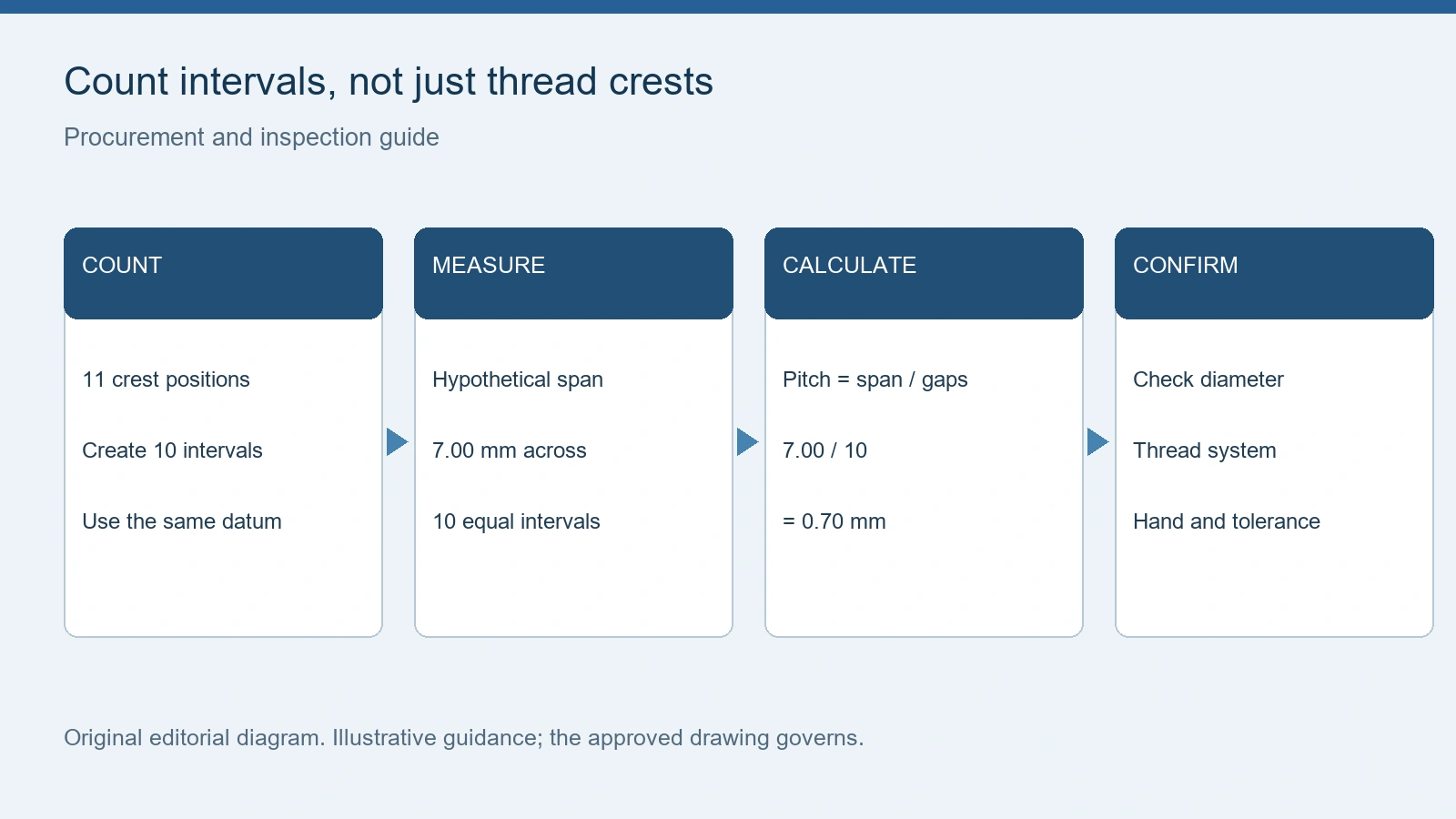
Choose an accessible, undamaged section of the external thread. Keep the measurement direction parallel to the screw axis. Mark two corresponding crests and count the spaces between them. Measuring from crest 1 to crest 11 spans ten intervals, not eleven.
For an illustrative span L = 7.00 mm across n = 10 intervals, pitch P = L/n = 0.70 mm. Dividing by eleven would produce about 0.636 mm, an error caused by counting endpoints instead of spaces. Measuring a longer span can reduce the influence of endpoint reading error on the average, provided the selected points and axial alignment are reliable.
Do not report more precision than the instrument and method justify. Short screws, damaged crests and poor access can make a span measurement unreliable. In those cases, record the limitation and use an appropriate gauge or a better inspection setup.
Use a pitch gauge as an identification aid
Select a gauge with the appropriate thread profile and unit system. Metric and Unified gauges commonly use a 60° profile, while Whitworth gauges use a 55° profile. Similar-looking leaves are not automatically suitable for every thread form.
Place the candidate leaf along a clean section and assess whether its teeth follow the thread consistently over the available length. Record the leaf marking rather than converting it from memory. A close visual fit is an identification clue, not a complete dimensional acceptance result. The specified inspection method remains necessary for production acceptance.
Keep observations separate from a guessed designation
Sample identity
Illustrative entry: Sample A, drawing revision pending
What remains unconfirmed: Lot traceability
Measurement method
Illustrative entry: Axial span over ten intervals
What remains unconfirmed: Instrument suitability and uncertainty
Measured span
Illustrative entry: 7.00 mm in this worked example
What remains unconfirmed: Repeatability on the actual sample
Calculated pitch
Illustrative entry: 0.70 mm
What remains unconfirmed: Thread diameter and profile
Designation
Illustrative entry: Candidate only; await drawing
What remains unconfirmed: Tolerance class, handedness and other requirements
Combine the pitch result with the measured diameter and the controlled drawing. A nominal designation should not be assigned solely because a measured diameter appears close to a familiar size. For an overview of thread systems, see our guide to screw thread types.
A practical purchase enquiry checklist
Provide the drawing or intended thread designation, pitch or TPI with units, thread direction, tolerance requirements and usable thread length. Add material, finish, quantity and inspection requirements separately. Include clear close-up photos for identification, while keeping measurement records as the basis for dimensional decisions.
When replacing an unidentified fastener, also identify the mating thread. Do not force a candidate screw into an assembly as a compatibility test. An apparently similar pitch may still belong to an incompatible thread form or diameter.
Frequently asked questions
How many spaces are between eleven crests?
Ten. Numbering the crest positions makes the endpoint distinction easier to check before calculating an average pitch.
Can I measure pitch from a product photograph?
A normal product image is unsuitable for a reliable dimensional result. Perspective, scaling and resolution affect the apparent spacing. Measure the actual part or use a controlled inspection image.
Does 20 TPI mean a 1.25 mm metric thread?
No. Its spacing converts to 1.27 mm. Even equal spacing would not establish full compatibility without the remaining thread specifications.
Does a matching pitch-gauge leaf prove the screw passes inspection?
No. Pitch identification does not verify all thread dimensions or tolerance requirements. Use the acceptance method specified for the part.
Get the thread requirement into the quotation
Contact Ruike with your thread drawing or sample information. Include the measured spacing, units and method, and flag any unidentified features so they can be resolved before ordering.
Cover: AI-assisted editorial illustration, not a photograph of production, testing or an actual order. Product photographs in the article are identified separately.